Built by an Accredited Audiologist · Australia

Tinnitus support, designed by an Audiologist.

An eight-week structured program, sound therapy tools, and CBT exercises in one app. No subscription.

$19 once · See what's inside
Not a meditation app
Not a chatbot
Not subscription-based
Not built by marketers
Approach

Built around what works in clinical care.

Most tinnitus apps offer a sound library and call it sound therapy. That's not what tinnitus management looks like in practice.

Stillwave was designed around the methods that audiologists actually use: sound therapy combined with cognitive behavioural skills, structured education, sleep work, and gradual habituation. It's the same shape you'd be walked through over months of clinical appointments — translated into something you can do at your own pace, on your own phone, and keep using long after the structured weeks end.

The lessons are written in plain language. There are no self-help platitudes, no exaggerated promises, no "cure your tinnitus in 7 days" claims. Tinnitus management is a slow, real process. Stillwave treats you accordingly.

Inside the app

Three things, working together.

01 — STRUCTURED PROGRAM

Eight weeks. Fifty-six lessons.

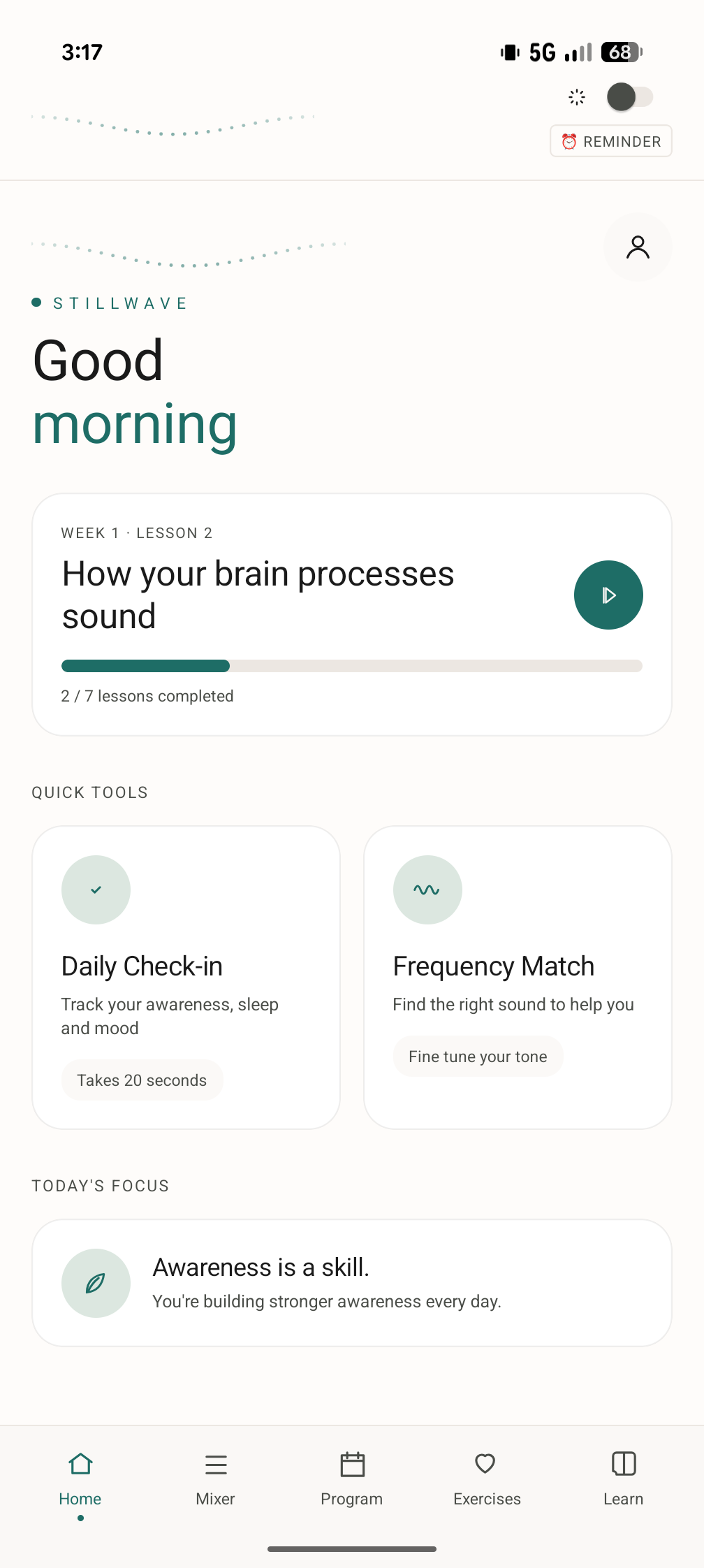
A daily clinical journey from understanding your tinnitus through habituation. Each lesson is short — about ten minutes — and you can move at your own pace.

02 — SOUND THERAPY TOOLKIT

Mixer, frequency matching, exercises.

The tools you'll keep using long after the program ends. Multi-layer sound mixer, frequency matching with notched therapy, and five guided CBT exercises.

03 — SELF CHECK-IN

Track your trajectory.

A 25-question self-check based on the standard subscale framework used in clinical research. Take it weekly. Watch the patterns over months.

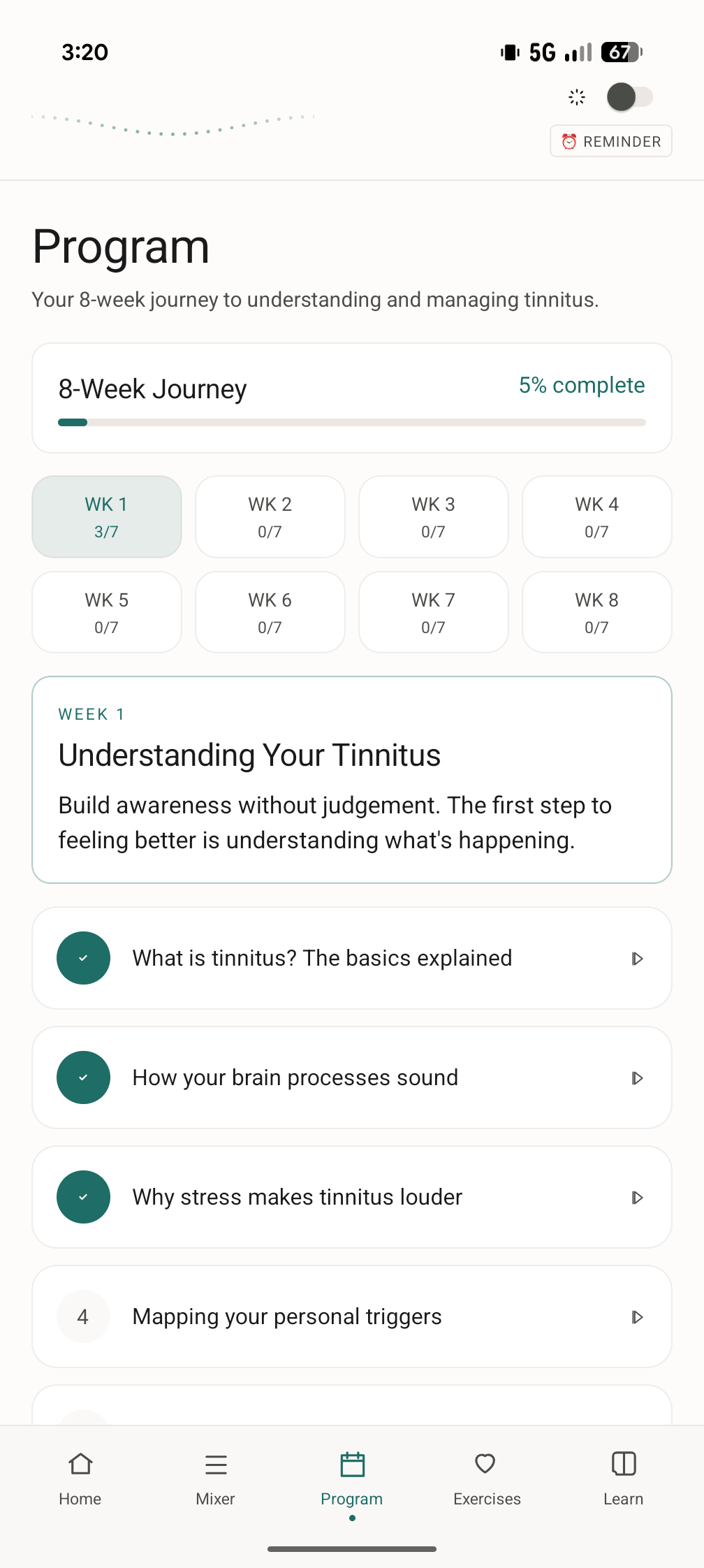
The 8-week program tab in light mode, showing Week 1's lessons
The program
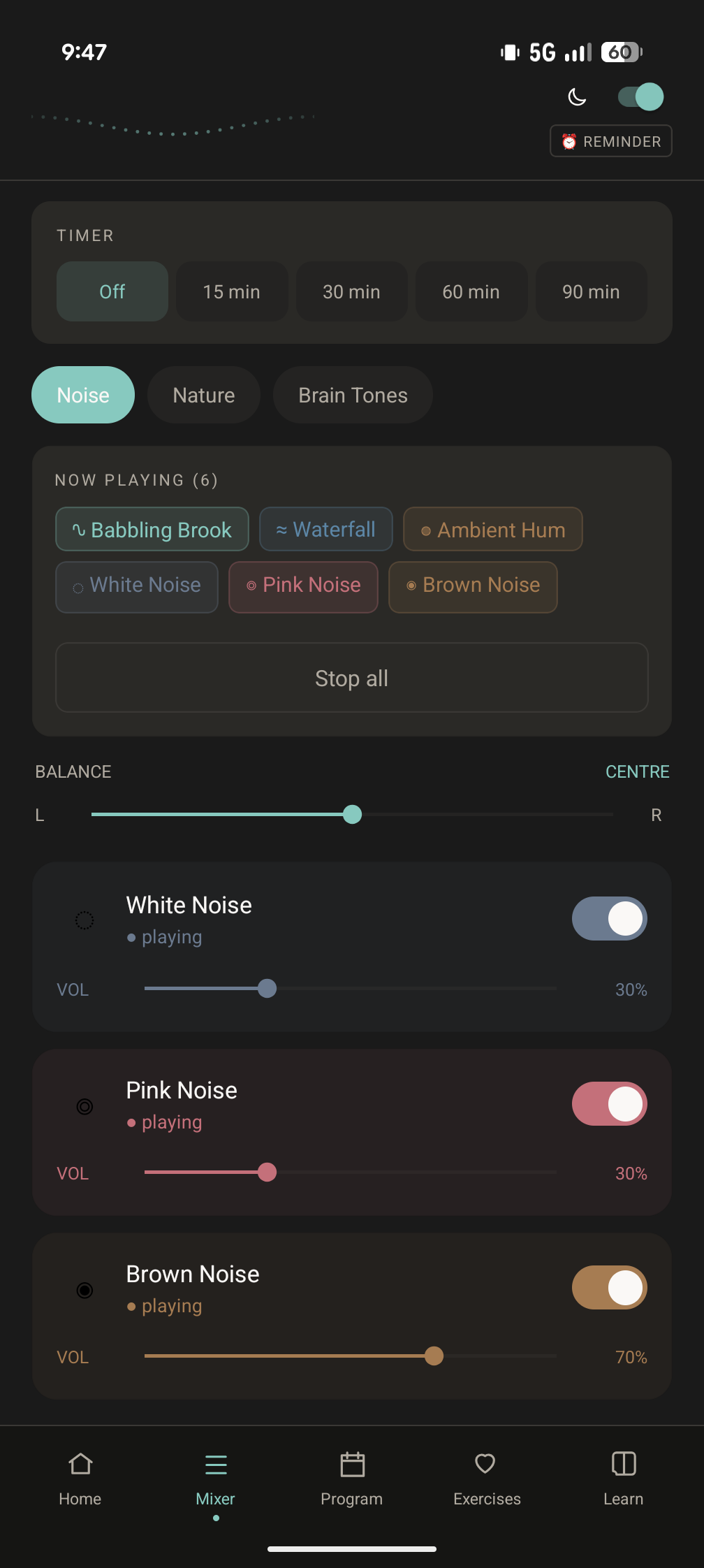
The mixer tab in dark mode, with sound layers and a sleep timer
The mixer
The Learn tab in light mode, showing clinical education articles
Learn
The program

Eight weeks. Fifty-six lessons.

Each week builds on the last. Each day takes about ten minutes. Move at your own pace — there's no streak counter, no guilt mechanism. Most people finish in about ten weeks, with breaks.

  1. Understanding your tinnitusWhat tinnitus is, how it works in the brain, why stress amplifies it, and what habituation actually means.
  2. Sound therapy foundationsThe mixing point, white-pink-brown noise, nature sounds, building a sleep soundscape, frequency matching.
  3. Breaking the anxiety cycleCBT skills for managing the attention-distress loop. Breathing, defusion, reframing, acceptance.
  4. Sleep masteryHygiene audit, evening wind-down, advanced soundscapes, managing 3am waking, brain tones.
  5. Concentration and workHow tinnitus affects focus, sound therapy for different work types, open-plan environments, video calls.
  6. Social and emotional wellbeingTalking to loved ones, social anxiety, self-compassion, peer support done well.
  7. Advanced habituationActive versus passive listening, managing spikes, silence exposure, the long-term mindset.
  8. Your long-term planBuilding a personalised maintenance routine. Future triggers. When to seek professional help.
Habituation is not silence. Most people who habituate to tinnitus can still hear it if they listen for it. The sound has not gone away. What has changed is the attention the brain gives it. From Week 7 of the program
The toolkit

Yours to use, day to day.

Beyond the program, Stillwave is built around tools you'll keep using indefinitely. Many users report the mixer and sleep timer are what they reach for most, years after completing the program.

01

Multi-layer sound mixer

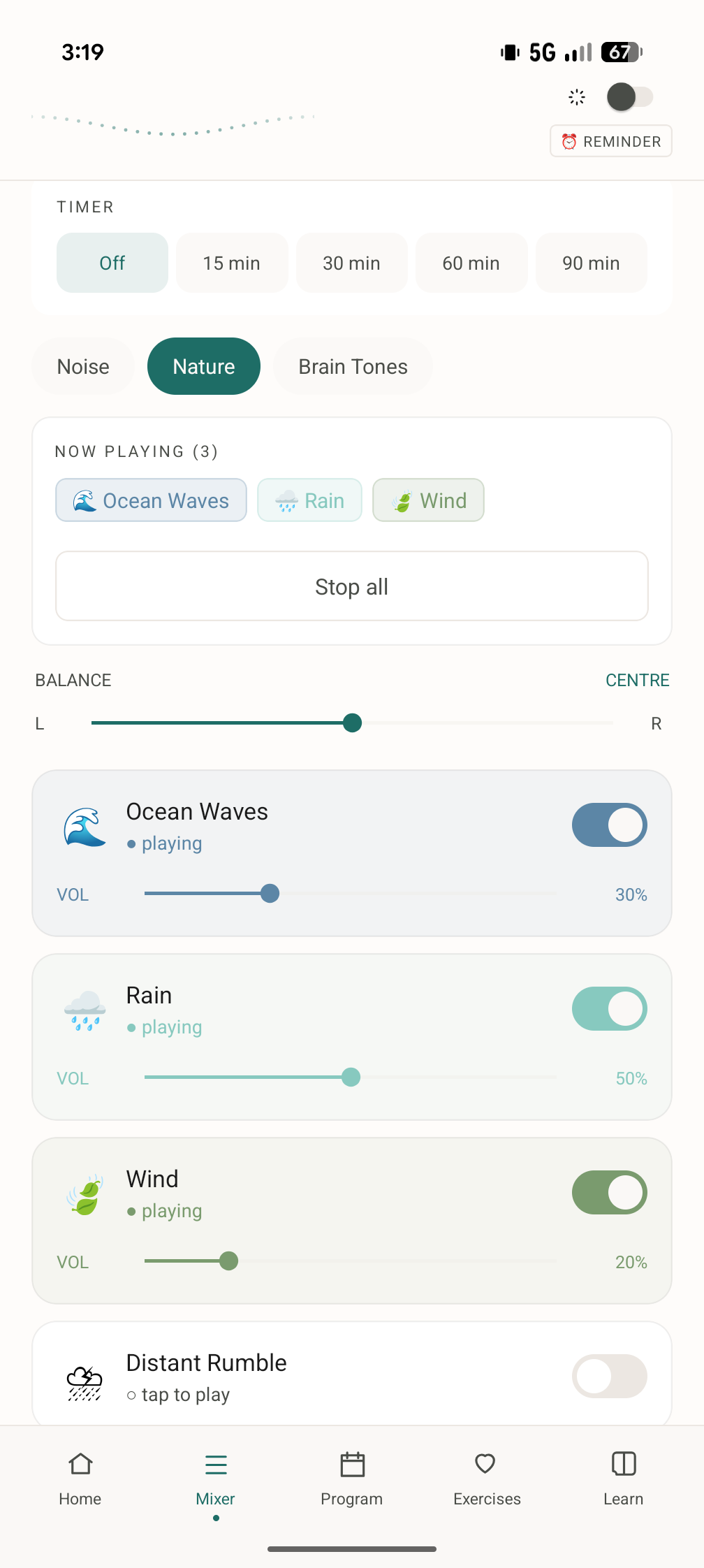
White, pink, brown noise; ocean, rain, wind, distant rumble; binaural delta and theta tones. Stack them, set per-layer volumes, save your combinations as named mixes. Audio continues when your screen is off, properly, with a media notification, for as long as you want.

02

Frequency matching

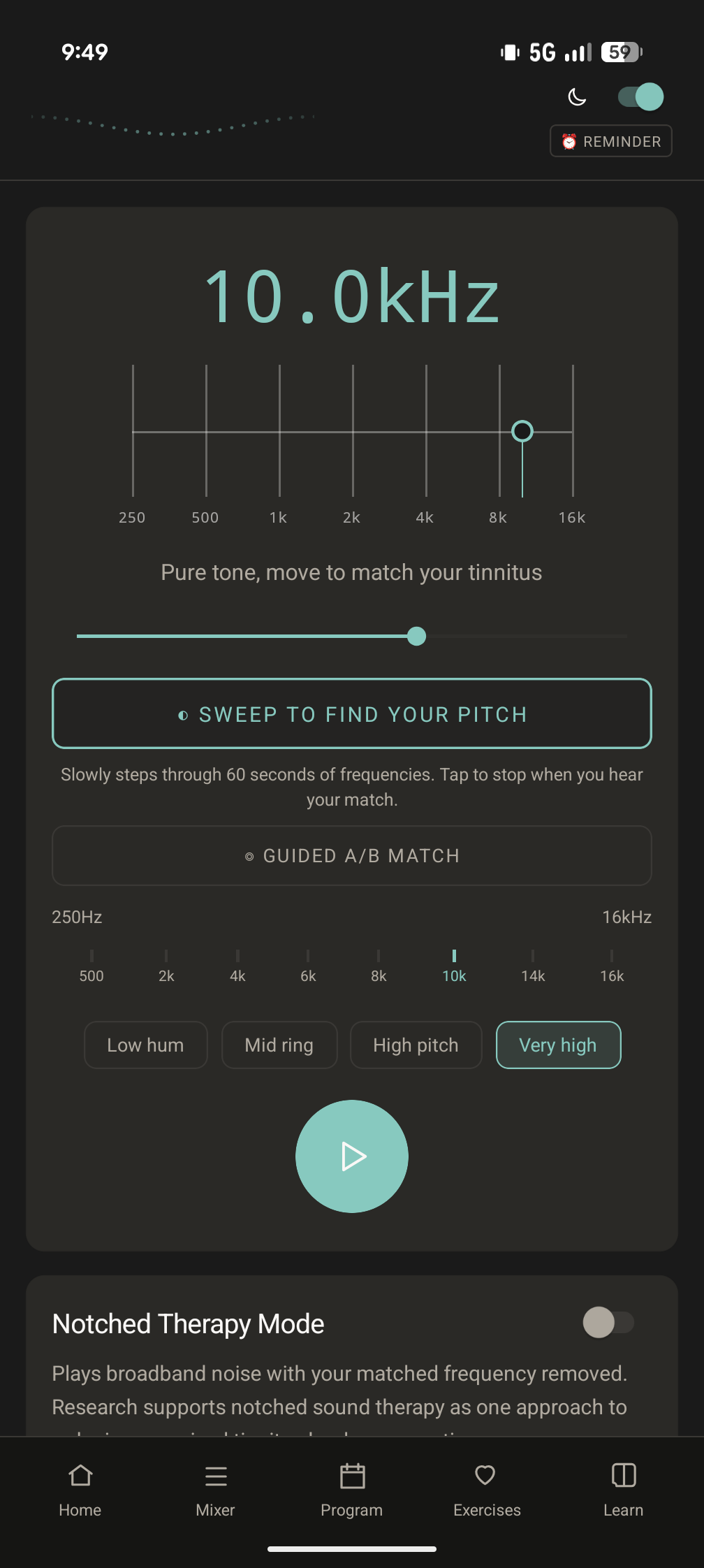
Find the pitch closest to your tinnitus across the audible range. Save your matched frequency. Switch to notched-noise mode for sound therapy targeted to your specific tone.

03

Five guided exercises

4-7-8 breathing, thought defusion, body scan, sound acceptance, gratitude anchoring. Drawn from CBT and ACT, timed and guided, designed for moments of acute distress.

04

Self check-in

A 25-question self-check, modelled on the standard clinical subscale framework. Track your trajectory across the program and beyond — a number that's independent of how today happened to feel.

05

Sleep timer with fade

Set a duration. The sound fades smoothly to silence at the end. The audio session is properly released, not suspended. Your phone goes back to normal.

Price

Pay once. Use forever.

Stillwave costs nineteen dollars. Once. There is no subscription, no annual renewal, no in-app upsell. You buy the app, you have the app.

$19
One-time · Lifetime access
  • The full eight-week program
  • All sound therapy tools
  • Frequency matching with notched therapy
  • All five CBT exercises
  • Full self check-in with history
  • Educational article library

For context: a single consultation appointment with an Audiologist typically costs over a hundred dollars and lasts one hour. Stillwave is nineteen dollars and gives you eight weeks of structured support, a full toolkit, and ongoing access.

We've priced it deliberately low because tinnitus is common, and not everyone can afford repeat visits to a clinician.

Launch

Coming to Google Play soon.

Join the waitlist

Be the first to know when Stillwave is live on Google Play. One email at launch — that's it. No follow-ups, no marketing.

We'll only email you once — at launch.

Thanks. We'll be in touch when Stillwave is live.

Privacy

Your data stays on your phone.

Stillwave has no accounts, no analytics, no third-party tracking, no advertising. The app makes no network requests once installed. Your sound preferences, your check-in scores, your program progress — all of it stored locally. We can't see it because we never receive it.

Regional resources for Australia, the US, and the UK are bundled with the app, not fetched from a server. Read the full privacy policy →

Questions

Things worth asking.

Is Stillwave a medical device?

No. Stillwave is a wellness app, not a medical device. It does not diagnose or treat tinnitus or any other condition. If you have new or worsening symptoms — sudden hearing changes, ear pain, dizziness, or anything concerning — please see your GP or audiologist. The safety screener at onboarding flags situations where professional assessment is the appropriate first step.

Will it work for me?

Sound therapy and CBT are the two most evidence-supported non-pharmacological approaches for tinnitus distress. Habituation is the clinical standard recommended by audiologists worldwide. Results vary, and improvement isn't linear. Most people in structured tinnitus programs see measurable progress between weeks four and twelve.

Why one-time, not subscription?

Because the wellness app subscription model is genuinely problematic. You're not buying ongoing content — you're buying a structured program plus a set of tools. Once you have them, they're yours. Subscription pricing for a one-time-program app is a mismatch between what's being sold and how it's being charged for.

Does the audio actually keep playing in the background?

Yes. This is the single most common failure point of tinnitus apps and we put significant work into solving it. Stillwave runs as a foreground service with a media notification, so audio continues with your screen off, your phone locked, you in another app — for as long as you want. The audio doesn't time out at 90 seconds like most of its competitors.

What happens after the eight weeks?

The structured program ends, but the app keeps working. Most people continue to use the sound mixer for sleep and work, return to specific exercises during stressful periods, and check in with their self-assessment monthly to confirm stable progress. The toolkit is what you keep.

What if I don't think it's helping?

Google Play offers refunds within their standard window after purchase. Beyond that, my honest answer: tinnitus management is genuinely slow work. If you've engaged with the program for at least four weeks and you're not noticing any change, please consider seeing your audiologist for a more thorough assessment. Apps work for many people; some need more direct clinical support.

About the builder

Stillwave was designed by an Accredited Audiologist based in Australia, drawing on years of clinical experience helping people manage tinnitus. The lessons reflect what actually works in clinical practice — including being honest about what doesn't.